Agricultural Producer Registration in Bulgaria (2026)
Register as an agricultural producer in Bulgaria: ODZ/OSZ procedure, land and animal documents, 2026 deadlines, tax, VAT, CAP, and BFSA boundaries.
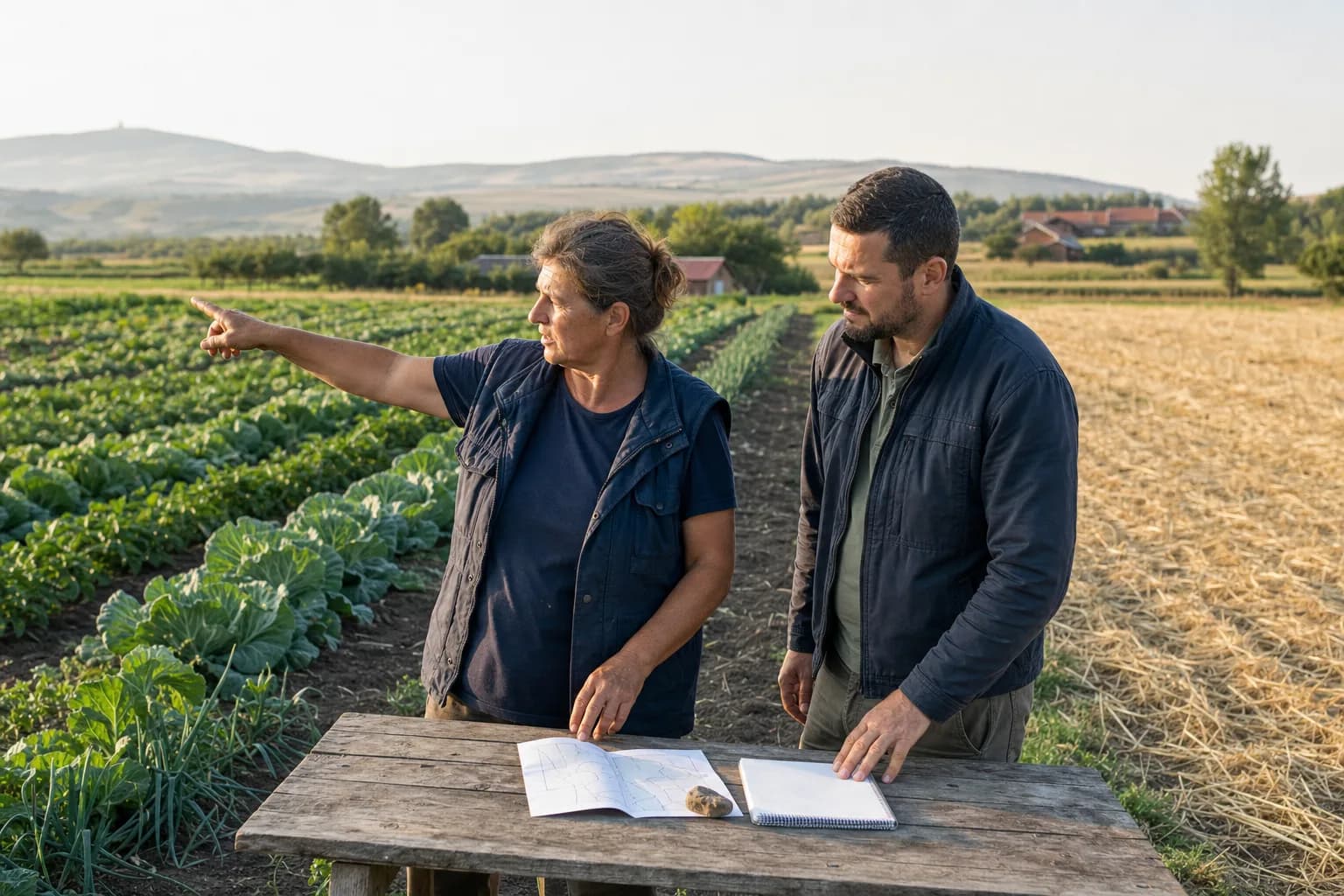
Registering as an agricultural producer in Bulgaria puts a farm and its declared activity into the Ministry of Agriculture and Food system. It can support funding applications and prove agricultural status, but it does not replace tax, social-insurance, food, animal, land-use, or Common Agricultural Policy (CAP) rules.
This guide reflects the position checked on 1 August 2026. Forms, annual campaign dates, tax thresholds, and support conditions change. Confirm the current requirements with the competent authority before filing. This is general information, not legal, tax, accounting, veterinary, food-safety, or subsidy advice.
Registration at a Glance
| Question | Current position |
|---|---|
| Main rules | Article 7 of the Agricultural Producers Support Act and Ordinance No. 3 of 29 January 1999 |
| Who may register? | An individual aged 18 or over, a sole trader, or a legal entity that manages agricultural land and/or produces agricultural products |
| Competent authority | Regional Directorate of Agriculture (ODZ) for the applicant's permanent address or registered office |
| Local role | The Municipal Agriculture Office (OSZ) checks and certifies survey forms and land data; it is not the municipal government |
| Core forms | Survey card and one or more survey forms; the ODZ issues a separate registration card and activity statement |
| Initial deadline | No fixed annual window for first registration |
| Fee | No administrative fee for the registration service |
| Annual update | From 1 October until the current direct-payments campaign deadline; 19 June applied for the 2025/2026 agricultural year |
| Changes or cessation | Update relevant changes within one month; request deregistration within one month after stopping |
| CAP support | Registration may be required, but it is not an approval or promise of payment |
What the Agricultural Register Does—and Does Not Do
Ordinance No. 3 creates a factual record of the producer, land, crops, animals, and certain primary-feed activities. A current registration card, the certified survey materials, and the register-generated activity statement are used before control bodies and financing institutions.
The entry also lets a producer with a card validated for the relevant agricultural year apply for agricultural-fund interventions and state aid. It permits an application; every programme retains its own eligibility tests.
Registration does not:
- form a company or limit personal liability;
- establish ownership or a valid right to use land;
- register an animal holding with the Bulgarian Food Safety Agency (BFSA);
- approve a food-production, processing, storage, or sales site;
- automatically make every grant tax-free;
- register the applicant for VAT; or
- confirm that the applicant is an “active farmer” for every CAP intervention.
If the farm will operate through an EOOD or OOD, complete the company-registration process first. The applicant in the agricultural register should match the person or entity that holds the land rights, animals, contracts, invoices, and intended support application.
Who Can Register
Article 3 covers three groups:
- individuals who are at least 18 years old;
- sole traders; and
- legal entities, including Bulgarian commercial companies and cooperatives.
The applicant must manage agricultural land and/or produce agricultural products. There is no universal minimum holding size in Ordinance No. 3 for the initial entry. A minimum area, number of animals, economic size, or production level may nevertheless apply under a particular support intervention.
An individual need not become a sole trader merely to enter the register. But an individual structure may expose personal assets, so compare liability, finance, accounting, tax, employment, and succession.
Foreign and EU Applicants
Ordinance No. 3 does not state a Bulgarian-nationality condition. In practice, however, it allocates an individual's file by permanent address and requires a usable Bulgarian identifier; a legal entity files by its registered office. A foreign individual may need a personal number or BULSTAT entry, residence documentation, and a Bulgarian address basis before the ODZ can process the file. The Registry Agency's official BULSTAT guidance explains the register and links to the current filing services.
Do not confuse eligibility to register with eligibility to own agricultural land. EU/EEA establishment, third-country residence, ownership, leases, and registered land-use grounds are separate questions. A properly documented right of use may support the file even where ownership is unavailable. Review residence, land, tax, and finance before choosing a Bulgarian company; see our business guide for foreign founders.
Authorities and the Current Forms
The ODZ maintains the regional register and issues the registration card. The competent ODZ is determined by the permanent address of an individual or sole trader and by the registered office of a legal entity.
The OSZ certifies the survey forms. It is a territorial agricultural-administration unit, not the mayor or municipal council. A separate form is completed for each zemlishte (the land territory associated with a settlement). The OSZ can send certified forms to the ODZ.
Use the current files published by an ODZ, not a saved form from an earlier campaign. The Ministry's current forms page includes the survey card, survey form, application, deregistration request, and primary-feed declaration versions published for the 2025/2026 cycle.
Documents to Prepare
The exact set follows the activity rather than a generic “company versus individual” checklist. Common items are:
- the current application, survey card, and survey form for every relevant zemlishte;
- an identity document for an individual to present for checking;
- EGN, personal number, UIC, or BULSTAT details as applicable;
- parcel identifiers, areas, crops, irrigation data, and the registered legal ground for using each agricultural parcel;
- evidence of the right to use land inside a regulated urban area, where the Ordinance requires documents rather than a register cross-check;
- the animal-holding number and lists of ear tags or electronic identifiers for animals subject to identification;
- a list of animals not individually identified, or a list certified by the official veterinarian controlling the holding; and
- the Annex 3 declaration where the farm conducts covered primary-feed production, on-site handling, storage, transport, or limited mixing for its own animals.
For agricultural land, include every parcel with a registered legal basis under Article 41 of the Agricultural Producers Support Act. The OSZ may supply registered parcel data, but this does not cure an expired, conflicting, or incorrectly registered lease.
Animal information is also checked through BFSA's identification system. Resolve differences in ear tags, species, owner, or animal-holding number before filing rather than expecting the ODZ to amend veterinary records.
Step-by-Step Registration Procedure
- Fix the operating identity. Decide whether the producer will be an individual, sole trader, or entity, then align land documents, animal records, banking, sales, and support plans with that identity.
- Download the current forms. Complete the survey card and a survey form for each zemlishte. Separate crop, parcel, irrigation, animal, and feed details accurately.
- Check land and animal source records. Confirm registered legal grounds with the OSZ and animal data with the competent veterinary/BFSA channel.
- Obtain OSZ certification. The relevant OSZ certifies the survey forms. Where several offices are involved, plan enough time for each verification.
- Complete the initial ODZ filing. Ordinance No. 3 requires personal presentation of the initial documents to the ODZ and collection of the registration card. Ask whether follow-up documents can use secure electronic delivery.
- Answer defects promptly. If the file is incomplete, the ODZ gives written notice within seven days and sets a correction period that cannot run beyond 30 days from the application date.
- Collect and check the result. Verify the registration card, certified survey copies, and register-generated activity statement before using them in another procedure.
The official administrative-services register describes the service as free and lists a seven-day service period. Corrections, multiple OSZ certifications, land conflicts, or animal-record discrepancies can extend the practical timetable.
Annual Updates, Changes, and Deregistration
Registration requires annual maintenance. The update period starts on 1 October and ends with the deadline under Article 12(1) of the current direct-payments filing ordinance. It is therefore unsafe to publish the same February or May date every year. For the 2025/2026 agricultural year, the ODZ's official 2026 notice set 19 June 2026 as the final date.
If no registered circumstance changed, the producer may use the prescribed no-change declaration rather than resubmitting all supporting evidence. If data changed, file the updated survey materials and proof. Missing the annual requirement removes the rights attached to Article 6 until a card is validated for the next agricultural year; it should not be described loosely as a permanent ban.
Changes to identity, legal form, contact details, primary-feed activities, land, or animals may be reported within one month. On cessation, the producer must apply for deregistration within one month and return the registration materials. Deregistration does not close a company, cancel revenue registrations, terminate leases, or deregister a BFSA site.
Registration Is Not a CAP Subsidy Award
The EU's 2023–2027 direct-payment rules require more than a national-register entry. A claimant may need to qualify as an active farmer, submit a separate annual aid application, have eligible land at its disposal, carry out agricultural activity, satisfy scheme-specific minimums, and observe conditionality and evidence rules.
The State Fund Agriculture, not the ODZ registration desk, assesses the support claim. A valid card can be a gateway document, but it creates neither an entitlement nor a fixed funding percentage. Eco-schemes, coupled support, young-farmer aid, investment calls, and state-aid schemes each have distinct conditions and budgets.
Tax, Social Security, and VAT
Agricultural registration and revenue registration are separate.
For an individual who is not taxed as a trader, the NRA's agricultural-income guidance currently explains a 10% personal-income-tax rate after statutory expenses of 60% for unprocessed agricultural products (other than ornamental plants) and 40% for processed products and ornamental plants. Subsidies enter the analysis; they are not all automatically exempt. An eligible individual may elect ET-style profit taxation at 15% under Article 29a for a multi-year period. An ET is already in that profit-based regime, while a company generally calculates 10% corporate tax on taxable profit. Special agricultural state-aid relief has detailed conditions and is not an automatic discount for every registrant. Our 2026 corporate-tax guide covers the company baseline.
For social insurance, the relevant statutory category is a physical person registered in the proper manner who produces plant and/or animal output intended for sale. Such a farmer is self-insured and normally declares the start, interruption, resumption, or end of work to the NRA within seven days. Pension-related cover and health insurance are mandatory under the applicable rules; sickness and maternity cover is optional. It is not unemployment insurance. From 1 August 2026, official NSSI guidance lists EUR 620.20 as the minimum and EUR 2,300 as the maximum monthly insurance-income base for self-insured persons, including registered farmers. Multiple insurance grounds and processed versus unprocessed production can change the calculation, so obtain payroll advice before suspending contributions.
Farmer registration also does not equal VAT registration. From 1 January 2026, an established person generally must apply within seven days after annual Bulgarian turnover exceeds EUR 51,130, according to the NRA's current VAT page. Intra-EU acquisitions, cross-border services, non-established suppliers, voluntary registration, and the EU small-enterprise scheme have separate tests that can apply before or independently of that threshold.
Food, Animals, and Other BFSA Boundaries
An agricultural-register card is not a food licence. Depending on the activity:
- an animal holding must be registered under the Veterinary Medical Activity Act through the official animal-holding registration service;
- a site that produces, processes, stores, or distributes food may need registration or approval under the Food Act—see our food-facility guide;
- direct supply of small quantities is governed by its own product, quantity, territory, hygiene, and record rules; and
- organic production, plant-health material, seeds, feed, pesticides, water, waste, retail markets, and employment may add further registrations.
Map the whole farm-to-customer chain before sales begin. The common compliance failure is obtaining the agricultural card and assuming that every later activity is covered by it.
Practical Risk Checklist
Before filing, confirm that:
- the producer named in the forms is the same person that uses the land and carries on the activity;
- each parcel has a current, registered legal basis and no unresolved overlap;
- OSZ, BFSA, veterinary, and applicant records use consistent animal and holding data;
- a separate survey form exists for every relevant zemlishte;
- the current campaign forms and annual deadline are being used;
- CAP, tax, VAT, social-insurance, food, and animal-site workstreams have separate owners; and
- the calendar includes one-month change and cessation notices.
Contact Lion Consult to coordinate the legal form, land-use documents, agricultural registration, and the connected corporate and compliance work before the farm applies for support or starts regulated sales.
Laws, administrative practice, campaign dates, and financial thresholds can change after publication. Obtain advice for the applicant, land, products, animals, and funding measure concerned; this article does not replace individual legal, tax, accounting, veterinary, food-safety, or subsidy advice.
Frequently Asked Questions
Who can register as an agricultural producer in Bulgaria?
An individual aged 18 or over, a sole trader, or a legal entity may register if it manages agricultural land and/or produces agricultural products. Ordinance No. 3 has no universal minimum holding size, although individual support schemes may impose one.
What is the difference between the OSZ and ODZ?
The Municipal Agriculture Office, or OSZ, checks land information and certifies survey forms. The Regional Directorate of Agriculture, or ODZ, maintains the register and issues the registration card for the applicant's permanent address or registered office.
Which documents are normally required?
Applicants use the current survey card and a survey form for each zemlishte, identification data, registered land-use information, and—where relevant—animal-holding and animal-identifier records. Covered primary-feed activity also requires the prescribed declaration.
What was the annual update deadline in 2026?
The period begins on 1 October and ends with the applicable direct-payments filing deadline, which can change each campaign. For the 2025/2026 agricultural year the official final date was 19 June 2026, not 28 February.
Does registration guarantee CAP subsidies?
No. A current registration can be a gateway requirement, but the separate aid application must still satisfy active-farmer, eligible-land or animal, agricultural-activity, minimum, evidence, conditionality, and intervention-specific rules.
Does farmer registration automatically determine tax, social insurance, or VAT?
No. Individual, sole-trader-style, and corporate tax regimes differ; only qualifying physical farmers fall into the specific self-insured category. That category uses a EUR 550.66 monthly minimum and EUR 2,111.64 maximum through 31 July 2026, and EUR 620.20 and EUR 2,300 respectively from 1 August 2026. VAT has separate rules; the general established-person threshold is annual Bulgarian turnover exceeding EUR 51,130, with a seven-day application rule.
Does the registration card authorise food sales or animal keeping?
Not by itself. Animal holdings require the applicable BFSA registration, food production or distribution sites may require Food Act registration or approval, and direct supply, feed, plant-health, organic, hygiene, and other rules may apply separately.