Fuel Trading Registration in Bulgaria (2026)
How Bulgaria registers fuel wholesale, retail, storage, transport and LPG businesses, with capital, security, excise, VAT and reporting rules.
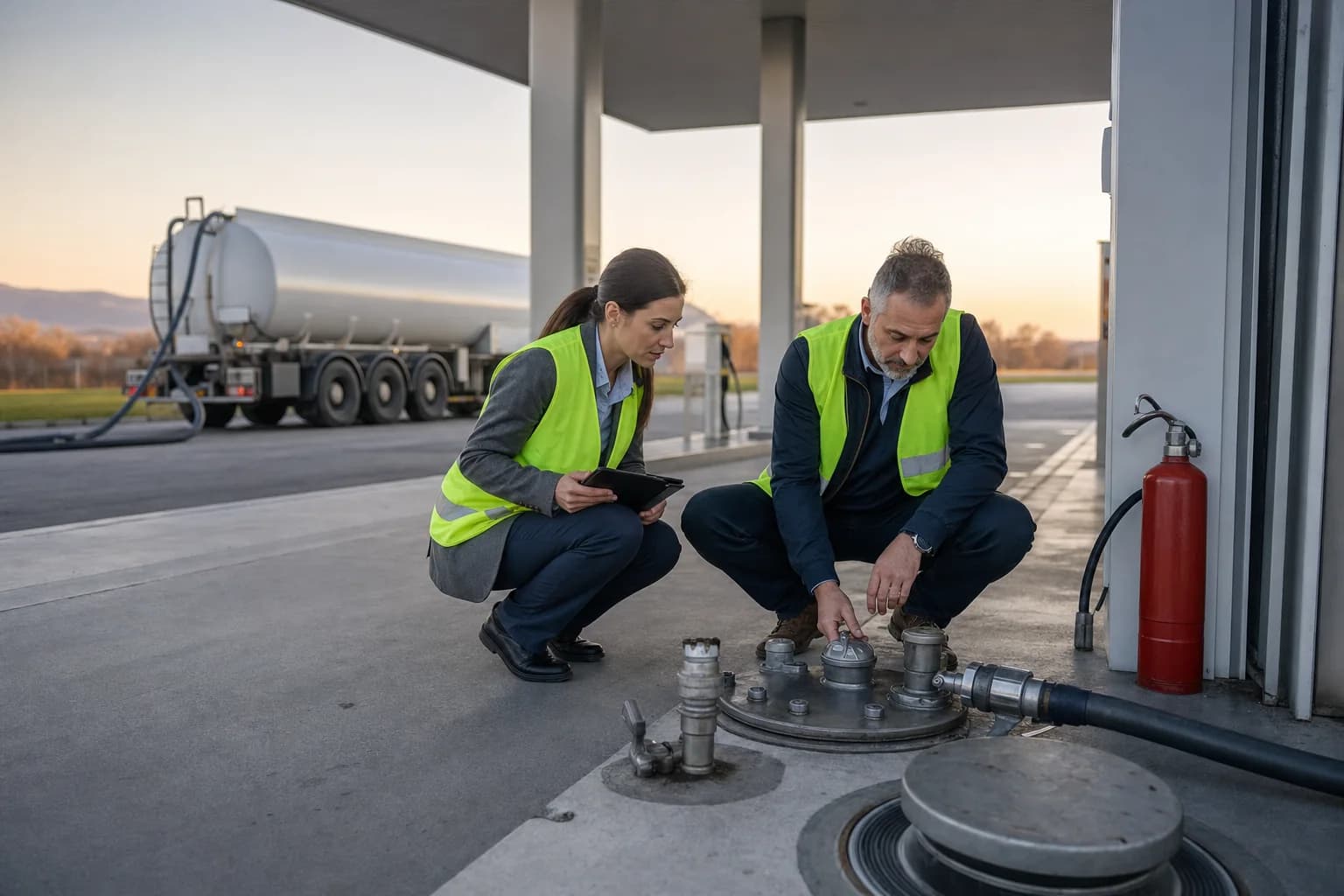
Fuel trading in Bulgaria is not covered by one universal licence. Before starting, an operator may need one or more entries in the Ministry of Economy and Industry register, while separate construction, metrology, fire-safety, excise, VAT, fiscal-reporting, transport, fuel-quality, and environmental rules apply to the same project.
Classification is therefore the first job. Wholesale, a public filling station, an internal refuelling point, third-party storage, tanker transport, LPG-cylinder filling, and cylinder distribution are distinct activities. Registration for one does not authorise another.
Fuel, tax, excise, transport, and renewable-energy rules change frequently. This guide reflects official sources available on 1 August 2026, provides general information, and does not replace project-specific legal, tax, customs, engineering, or environmental advice.
Fuel-Activity Registration at a Glance
| Question | General position |
|---|---|
| Registration authority | Minister of Economy and Industry; public register |
| Principal regime | Law on Administrative Regulation of Economic Activities Related to Oil and Products of Petroleum Origin (ZARIDSNPNP) |
| Covered categories | Wholesale, retail, non-excise storage, transport, LPG-cylinder filling, and LPG-cylinder distribution |
| Separate entries | A separate registration is made for each activity category |
| State fee | No fee for the registration service |
| Initial document review | Up to seven working days |
| Correction period | Up to 14 working days after notification |
| Ministry security | Required for wholesale, storage, and both LPG-cylinder categories; not retail or transport |
| Certificate | Copy displayed at the registered site or carried in each registered vehicle |
| Important parallel regimes | Customs/excise, NRA reporting and fiscal systems, construction, fire safety, metrology, ADR, fuel quality, and renewables |
Which Activities Need Registration?
The Ministry's official consolidated fuel-activities law identifies six operational categories:
- wholesale distribution of oil or petroleum products in Bulgaria
- retail sale through a filling station, or refuelling the operator's own vehicles and machinery through an internal site
- physical storage, receipt, transfer, and release outside an excise tax warehouse or registered consignee's storage facility
- transport, including qualifying road-tanker and rail operations
- commercial filling of LPG cylinders outside an excise tax warehouse
- distribution of filled LPG cylinders
The law does not classify a transaction as wholesale merely because it exceeds 1,000 litres. Wholesale is distribution other than statutory retail; retail covers filling-station sales and own-use refuelling through internal sites.
Marine or aviation bunkering is not a separate Ministry-registration category. A supply may fall within wholesale, transport, or storage and may also use a specific excise treatment. Do not infer an exemption from the customer being a ship or aircraft; check the transaction against both the registration law and the Excise Duties and Tax Warehouses Act.
Important Exclusions and Narrow Exceptions
The regime excludes oil and gas exploration and extraction, solid petroleum products, specified excise-exempt deliveries, and certain fuel production from waste tyres or plastic. State and local authorities acting as public authorities are not registered.
An unregistered retailer may sell filled LPG cylinders only under the statutory arrangement with a registered cylinder distributor. Waste operators have a narrow own-use rule. A registered agricultural producer may temporarily store and dispense its own fuel without this registration where all conditions are met, including no resale, aggregate capacity up to 50 m³, compliant measurement/reporting, and eligible agricultural use.
Applicant, Capital, and Security Requirements
An applicant must be a trader registered under Bulgarian commercial or cooperative law, or under the law of another EU/EEA state. It cannot be in insolvency or liquidation, have disqualifying public liabilities or emergency-stock defaults, or have a VAT registration terminated on the specified anti-abuse ground. Owners, managers, representatives, and supervisory personnel must satisfy the criminal-record, insolvency, and legal-capacity conditions.
Where the legislation still expresses a legacy lev amount, the euro figures below use the irrevocable conversion rate of EUR 1 = BGN 1.95583 and ordinary statutory rounding:
| Activity | Capital/assets requirement | Ministry security |
|---|---|---|
| Wholesale or storage: new operator/revenue up to BGN 5m | EUR 25,564.59 | EUR 7,669.38 |
| Revenue BGN 5m–10m | EUR 51,129.19 | EUR 15,338.76 |
| Revenue BGN 10m–20m | EUR 102,258.38 | EUR 30,677.51 |
| Revenue BGN 20m–50m | EUR 255,645.94 | EUR 51,129.19 |
| Revenue above BGN 50m | EUR 511,291.88 | EUR 255,645.94 |
| Retail | EUR 10,225.84 per site | None under this law |
| Road or rail transport | No specific minimum under this law | None under this law |
| LPG-cylinder filling | EUR 10,225.84 | EUR 10,225.84 |
| LPG-cylinder distribution | EUR 10,225.84 | EUR 51,129.19 |
For wholesale and storage, the company term stated in its founding document must extend for at least two years and six months from filing. The requirement is satisfied through paid capital or assets as prescribed, not by an unsupported shareholder promise.
Security is a cash deposit with the Ministry or an unconditional, irrevocable bank guarantee. Its term must be at least 18 months from filing. A replacement is due no later than 14 days before expiry. Retail and transport are exempt from this Ministry security, but the separate VAT-security mechanism may still apply.
Sites, Storage, Transport, and LPG
Filling Stations and Internal Sites
A public filling station must be permanently attached to real property, lawfully commissioned or recognised as a tolerable construction under spatial-development law, and connected to the NRA reporting arrangement required by Article 118(6) of the VAT Act. A compliant Bulgarian company structure is only the starting point; Commercial Register entry does not validate the site.
An internal site is for refuelling the operator's own vehicles, off-road machinery, and equipment. It may be fixed or, where permitted, movable and must satisfy the applicable Article 118(8) reporting rules. It cannot ordinarily refuel third parties. A filling station and internal site cannot share tanks or volume/flow measuring equipment.
Storage
A non-tax-warehouse storage operator needs owned or leased tanks and lawful rights over the site. The fixed facility must have appropriate construction status, compliant measuring instruments, real-time automated stock accounting, traceable ownership of stored product, security controls, fire protection, and durable identification of tanks, capacity, and product.
An excise tax warehouse licence is a different Customs Agency status. Storage under duty suspension is not converted into ordinary Ministry-registered storage simply by obtaining this registration.
Transport and LPG Cylinders
Road vehicles must meet road-transport and applicable ADR requirements. Measurement equipment is checked through the competent authorities, except for vehicles used only for deliveries without commercial payment where the statutory declaration applies. Rail vehicles follow railway-transport requirements.
An LPG filling site must have lawful construction status and pass the applicable technical-safety requirements for liquefied-hydrocarbon-gas installations. A distributor needs at least 1,000 owned LPG cylinders and a filling contract with a registered filler or licensed excise warehouse unless it holds the relevant filling status itself. Filling pressure vessels anywhere else is prohibited.
Application Documents
Use the activity-specific form and checklist on the official e-government service page. Each category needs its own application, although one filing may list multiple sites or vehicles.
A typical file includes:
- applicant identity, activity description, petroleum-product names, and current EU Combined Nomenclature codes
- acquisition and operating routes, including import or intra-EU arrivals
- registered-office occupancy evidence and foreign-company representative evidence where applicable
- proof of the Ministry cash deposit or original bank guarantee, except for retail and transport
- lists and identifying data for sites, tanks, facilities, vehicles, or cylinders
- technological diagrams for retail and storage showing tanks, pumps, pipes, and loading points
- declarations covering the general and category-specific conditions
- title or use documents, cadastral/site plan, and precise GPS coordinates for retail, storage, and LPG-filling sites
- commissioning, tolerable-construction, or movable-site evidence where required
- transport declarations and category-specific capital, asset, cylinder, contract, metrology, or safety evidence
Coordinates, tank and vehicle details, CN codes, plans, and NRA records must reconcile because registration is site-, vehicle-, product-, and activity-specific.
Procedure, Timing, and 2026 Fee
- Map the model. Identify every activity, site, vehicle, product, title to stock, excise status, and customer type.
- Build the company and financial evidence. Verify eligibility, corporate term, capital/assets, revenue band, tax status, responsible persons, and security.
- Validate technical readiness. Complete construction, fire, metrology, transport, tank-accounting, and NRA integration work before filing site evidence.
- Submit separately by activity. Filing is available through the e-government portal, secure electronic delivery, email where accepted, post, or the Ministry service centre.
- Answer deficiencies. Officials check the documents within seven working days. The Ministry then notifies identified deficiencies within seven working days after review; the applicant has 14 working days to cure them.
- Receive entry or refusal. Within ten working days after a clean review or cure, officials make their proposal to the Minister or authorised deputy minister. The official service describes the final stage as up to 14 days from that proposal.
The registration service is free of state charge in 2026. Capital, security, engineering, fiscal systems, excise authorisations, and professional work still carry costs. Registration has no routine expiry, but continuing compliance and valid security remain essential.
Excise, VAT, Fiscal Devices, and Reporting Are Separate
Registration with the Ministry does not authorise production, processing, receipt, or holding under excise-duty suspension. Those operations may require licensed-warehousekeeper, tax-warehouse, registered-consignee, or other status from the Customs Agency. The Agency's excise-business hub links the current Excise Duties and Tax Warehouses Act, systems, and procedures.
From 1 January 2026, an established Bulgarian person generally crosses the compulsory VAT-registration threshold when annual domestic turnover exceeds EUR 51,130, according to the current NRA registration guidance. Other VAT-registration grounds can arise earlier, particularly for foreign operators or intra-EU acquisitions.
Article 176v VAT security is another separate obligation. The NRA fuel-trading guidance applies it when relevant supplies, intra-EU acquisitions, or receipts released for consumption exceed the legacy BGN 25,000 threshold—EUR 12,782.30 after conversion—in the current tax period. The security is not a flat EUR 12,782.30 minimum: it must be at least 20% of the applicable tax base for the preceding period, lasts one year, and is provided in cash, government securities, or an unconditional bank guarantee. Statutory exemptions must be checked transaction by transaction.
Depending on the operation, NRA compliance also includes:
- an electronic system with fiscal memory and measuring equipment at retail sites
- remote data and level-measurement integration under Ordinance N-18
- reporting of fuel deliveries and movements under Article 118(10)
- registration of own-use tanks and facilities under Article 118(8)
- monthly purchase-price information where fuel is sold through flow meters
- high-fiscal-risk-goods pre-declaration and control rules for relevant movements
Fuel Quality, Renewables, and Ongoing Compliance
Fuel placed on the market must meet Bulgarian and EU quality specifications. The State Agency for Metrological and Technical Surveillance controls liquid-fuel quality and measuring instruments, while customs and revenue authorities control excise and tax records.
Where an operator places transport fuels containing biofuel or renewable components on the market, it must also assess the Energy from Renewable Sources Act, sustainability and greenhouse-gas-saving evidence, mass-balance documentation, blending specifications, and current reporting duties. The EU framework is set by the consolidated Renewable Energy Directive. Obligations attach to the operator's precise role and product. A “biodiesel” label alone does not determine registration: composition, CN code, and any petroleum blend must be checked.
After registration, the operator should:
- use only registered sites and vehicles for the registered scope
- display the certificate copy at each site and carry it in each transport vehicle
- report changes to registered circumstances within seven days
- renew or adjust Ministry security on time
- reconcile physical stock, invoices, excise documents, fiscal data, tank readings, and CN codes
- maintain construction, fire, ADR, metrology, environmental, workplace-safety, and fuel-quality compliance
- monitor emergency-stock obligations where imports or intra-EU arrivals create them
Staffing and hazardous-work controls should be planned with the operator's occupational-health service. If the station shop prepares or sells food beyond ordinary prepacked retail, assess the separate food-facility regime.
Sanctions and Practical Risk Controls
Operating without registration, outside its scope, or contrary to a registration condition can trigger immediate cessation and sealing until compliance. For a company, the principal property sanction converts from BGN 25,000–250,000 to approximately EUR 12,782.30–127,822.97; repeat sanctions are higher. Unregistered transport can also lead to forfeiture of fuel, vehicles, and equipment. A site involved in specified violations may be barred from registration for two years.
Common failures include registering wholesale but not storage or transport, using an internal site for third parties, assuming tax-warehouse status replaces every Ministry entry, under-securing after revenue grows, omitting a new vehicle, and treating NRA, Customs, or sustainability reporting as part of the Ministry certificate.
Before buying a site or fleet, prepare one matrix covering the legal entity, each activity, every object and vehicle, product/CN code, title to fuel, customer, stock location, excise status, fiscal flow, and regulator. That map prevents the most expensive category errors.
Lion Consult can coordinate the company, activity classification, Ministry registration, security, site-document, and parallel tax/customs workstreams. Contact our team for a scope-based review before acquiring premises, ordering tanks, or commencing fuel movements.
This article is an informational overview, not legal, tax, customs, engineering, environmental, transport, or investment advice. Confirm the current forms, euro amounts, bank details, technical approvals, product classification, and regulator guidance for the specific operation before acting.
Frequently Asked Questions
Which fuel activities require registration in Bulgaria?
Separate Ministry registration applies to wholesale, retail through filling stations or internal sites, qualifying storage outside the excise-warehouse system, transport, LPG-cylinder filling, and LPG-cylinder distribution. Registration for one category does not authorise another.
Does a Bulgarian filling station need fuel registration?
Yes. Public filling-station retail is a registered activity and each site must be included. The holder needs paid capital or assets equivalent to EUR 10,225.84 per site. Retail has no separate Ministry security under this law, although VAT security and NRA fiscal obligations may apply.
What capital and security does a new wholesale fuel trader need?
A new wholesaler, or one with prior-year net sales up to the legacy BGN 5 million band, needs capital or assets equivalent to EUR 25,564.59 and Ministry security of EUR 7,669.38. Higher revenue bands increase both amounts, and Article 176v VAT security is a separate assessment.
How long does fuel registration take and is there a fee?
The official service is free. The Ministry reviews documents within seven working days, allows 14 working days to cure notified deficiencies, and officials make their proposal within ten working days after a clean review or cure. The final service stage is described as up to 14 days from that proposal.
Can an agricultural producer store fuel without this registration?
A narrow own-use exclusion applies where all statutory conditions are met, including no resale, aggregate vessel or tank capacity of no more than 50 cubic metres, compliant measurement and reporting, and use for eligible agricultural machinery.
Does a Customs tax-warehouse licence replace Ministry fuel registration?
No. Excise storage under duty suspension is a Customs Agency regime, while wholesale, transport, retail, or other activities may independently require Ministry registration. The operator must classify each part of its actual model.
What NRA obligations apply to fuel traders in 2026?
Relevant operators may need VAT registration, Article 176v security, electronic fiscal-memory and measuring systems, remote tank-level reporting, delivery and movement declarations, own-use tank registration, monthly purchase-price reporting, and high-fiscal-risk-goods compliance.