Hotel and Guest House Categorization in Bulgaria (2026)
Learn how to categorize a hotel, family hotel or guest house in Bulgaria in 2026, including authorities, documents, inspections, fees and renewal.
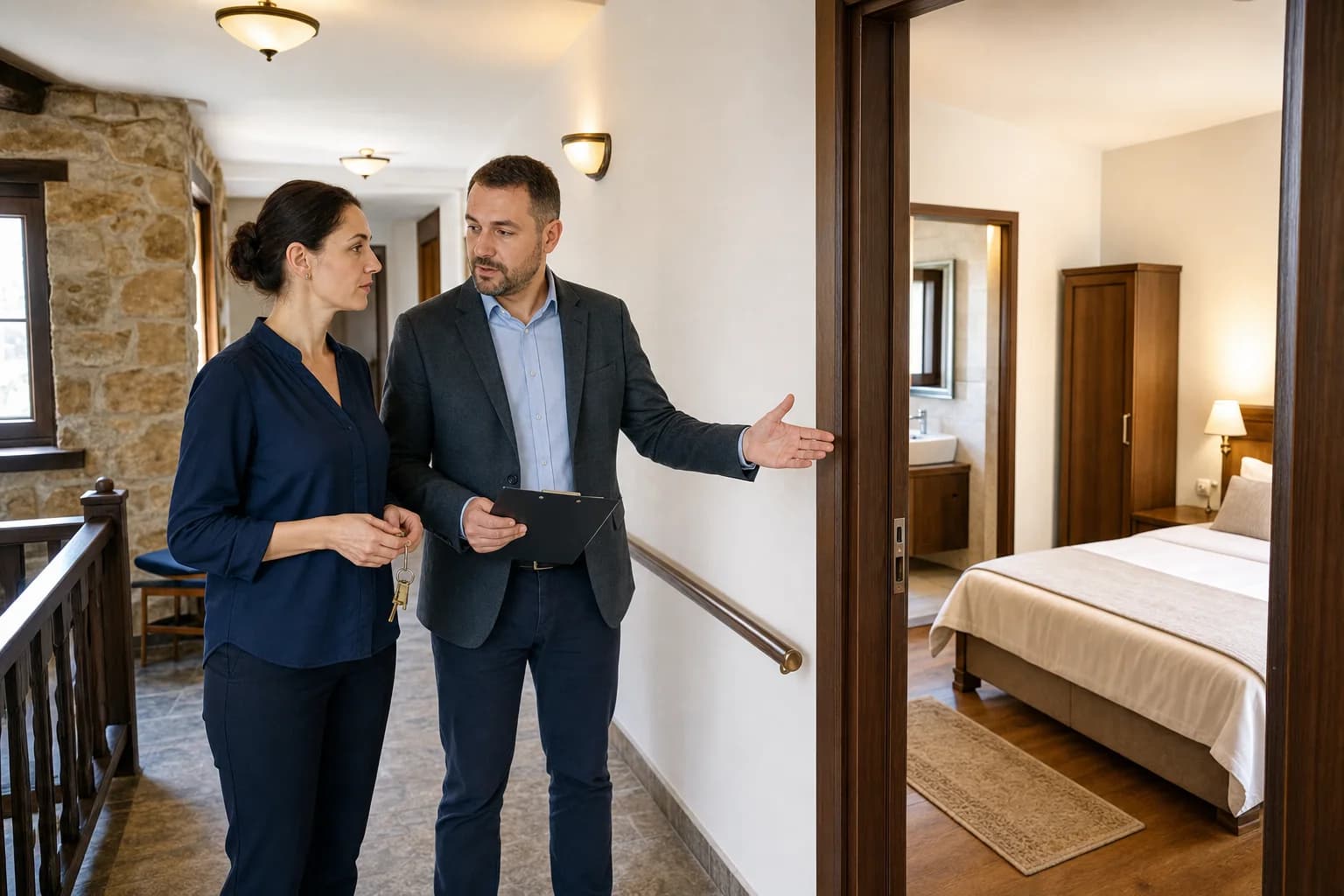
Opening a hotel, family hotel, guest house, or short-stay apartment in Bulgaria starts with a classification question. The legal label determines whether the property needs a star category or a simpler registration, which authority deals with it, what must exist on site, and which operating duties follow.
Choose the type before fitting out the building or publishing a listing. A property marketed under the wrong label can fail inspection even when its rooms are attractive, because Bulgarian law defines each accommodation type by its capacity, layout, services, and operating model.
This guide provides general information as at 1 August 2026. It is not legal, tax, planning, construction, fire-safety, food-safety, or employment advice for a particular property.
Accommodation Approval at a Glance
| Property model | Legal route | Category or status | Competent authority |
|---|---|---|---|
| Hotel | Class A categorisation | One to five stars | Municipal mayor for one or two stars; Minister of Tourism for three to five stars |
| Family hotel | Class B categorisation | One to three stars | Municipal mayor |
| Guest house | Class B categorisation | One to three stars | Municipal mayor |
| Guest rooms | Class C registration | No stars; registration certificate | Municipal mayor |
| Guest apartment | Class C registration | No stars; registration certificate | Municipal mayor |
Categorised accommodation receives a certificate and category plate for five years. Class C guest-room and guest-apartment registration is indefinite, but it does not create a star category. Every approved establishment is entered in the public National Tourism Register.
Hotel, Family Hotel, Guest House, or Guest Rooms?
The definitions in the official Tourism Act are substantive, not marketing choices.
A hotel is Class A accommodation and may obtain one to five stars. The applicable checklist varies by star level, location, season and function. A business cannot avoid the higher-category authority simply by describing a large hotel as a guest house.
A family hotel is a building with 5 to 20 guest rooms, local architectural character, personal service by hosts or staff, and at least one food and entertainment establishment. It is Class B and may obtain one, two, or three stars.
A guest house is a low-rise residential building with no more than 10 guest rooms. Guests use shared facilities such as a living room, equipped kitchen, dining area, and outdoor rest area. The hosts live in the same building or next door and provide personal service and at least breakfast. A guest house is also Class B and receives one to three stars.
Guest rooms are up to five rooms in one building, whether independent or within apartments. Guest apartments are independent apartments in one residential building. Since the 2020 reform these are Class C: the mayor registers them without assigning stars. Their simplified route should not be confused with guest-house categorisation.
The Tourism Act permits a non-trader natural person to operate guest rooms, guest apartments, or a guest house, including within an occupied home. Hotels and family hotels normally require a trader or another legal person entitled to conduct business. Investors choosing a company can start with our guide to company registration in Bulgaria.
Stars and the Correct Authority
The Minister of Tourism or an authorised official categorises hotels seeking three, four, or five stars, as well as all categories of apartment tourist complexes, villa settlements, tourist settlements, and villas. The municipal mayor or an authorised official handles one- and two-star hotels and all categories of family hotels, guest houses, motels, hostels, boarding houses, holiday stations, bungalows, and campsites.
This split also changes the timetable. A Ministry temporary certificate is valid for four months, while the temporary certificate for an object within the mayor's competence is valid for three months. A blanket four-month assumption is therefore unsafe for a guest house or family hotel.
Premises, Manager, and Service Requirements
The current accommodation ordinance contains detailed, category-specific schedules. Inspectors assess construction, furnishing, equipment, service, available facilities, manager qualifications, and language competence. Compliance is not established by room count alone.
For hotels, the higher the category, the more demanding the entrance, reception, accessibility, room, bathroom, housekeeping, communication, security, and service requirements. The manager of a one- or two-star hotel needs at least secondary education. A three-star hotel manager needs secondary education, one year's tourism experience, and one foreign language. Four-star and five-star hotel managers need higher education, one foreign language, and respectively four or five years' tourism experience.
Family hotels need a maintained facade, reception area, en-suite sanitary facilities, appropriate heating and category-dependent room equipment. The three-star manager route adds tourism experience and foreign-language competence. The ordinance also prescribes housekeeping frequency, guest information, price display, and the food outlet required by the statutory definition.
Guest houses follow a host-based model. Across all three categories they require a maintained and safe building, heating when used in winter, clean shared areas, an equipped kitchen and dining space, daily cleaning, guest-room keys, a visible price list, and the defined host presence. Star level affects matters such as room size, sanitary-facility ratios, furnishings, linen changes, and services. Personal belongings of the hosts should not remain in guest rooms.
Before signing a lease, verify lawful building use, commissioning or occupancy status, cadastral identity, fire measures, accessibility, sanitation, ventilation, water and electrical capacity, and any condominium constraints. Categorisation does not legalise an unsuitable building. If breakfast or other food is prepared, map the separate food-law position early; see our guide to food-facility registration in Bulgaria. Calling a property a “SPA hotel” also requires an appropriately certified adjacent centre, explained in our SPA and wellness certification guide.
Application Documents and Readiness File
The applicant files the official Bulgarian-language application-declaration with the competent authority. It identifies the operator and establishment in Bulgarian and Latin characters, address, capacity, requested type and category, contact details, commercial identifier where applicable, right to use the premises, and the manager and staff qualifications required for the chosen category.
The statutory attachment list is relatively short because registry, occupancy, and qualification matters may be checked officially or during inspection. A copy of the premises-use document is attached where the applicant is not the owner and that document is not entered in a public register. An express power of attorney is attached where an agent files.
Do not mistake a short attachment list for a light evidential burden. Keep a readiness file containing:
- title, lease or other use right and cadastral information
- commissioning, occupancy, approved-use, and relevant building records
- room and bed schedule, floor plans, and a checklist for the requested stars
- manager and staff diplomas, experience, training, and language evidence
- fire, accessibility, hygiene, maintenance, and emergency records
- food, pool, wellness, or other activity-specific registrations where relevant
- guest-register, privacy, pricing, invoicing, and tourist-tax procedures
Confirm the current form and filing channel with the relevant municipality or the Ministry's accommodation categorisation service before submission.
Categorisation Procedure and Inspection
The usual sequence is:
- File and pay the document-review fee. The application goes to the Ministry or municipality according to type and requested stars.
- Document review. Officials review the file within 14 days. If something is incomplete or irregular, the applicant normally receives 14 days from notice to cure it. Failure can result in refusal.
- Temporary certificate. A compliant file opens the procedure. The temporary certificate permits operation during its three-month municipal or four-month Ministry validity.
- On-site inspection. An expert working group compares the actual premises, staffing, equipment, and services with the requested category schedule and records its findings.
- Final decision and NTR entry. The authority may grant the requested or factually established type and category, or refuse. Category symbols are collected after the second fee is paid and displayed prominently.
If an inspection is not completed for reasons outside the operator's control, the temporary certificate may be extended once for a case-specific period. A refusal prevents a fresh categorisation application for the same object for six months after the refusal becomes final.
Class C registration is different. The mayor gives an incomplete application a three-day correction period and, for a compliant file, issues the registration order and indefinite certificate within seven days. There is no temporary certificate, star inspection, or five-year renewal cycle.
Official Fees in 2026
The Tourism Act fee tariff, amended by Council of Ministers Decree No. 190/2025, now states euro amounts. Categorisation has two equal stages: document review at filing, then NTR entry and category symbols after approval.
| Object and capacity | Fee at each categorisation stage | Combined two-stage fee |
|---|---|---|
| Class A hotel, up to 30 rooms | EUR 102.26 | EUR 204.52 |
| Class A hotel, 31–150 rooms | EUR 255.65 | EUR 511.30 |
| Class A hotel, 151–300 rooms | EUR 460.16 | EUR 920.32 |
| Class A hotel, 301–500 rooms | EUR 639.11 | EUR 1,278.22 |
| Class A hotel, over 500 rooms | EUR 1,150.41 | EUR 2,300.82 |
| Family hotel, up to 20 rooms | EUR 51.13 | EUR 102.26 |
| Guest house | EUR 5.11 per bed | EUR 10.22 per bed |
Class C guest-room or guest-apartment registration is a single EUR 10.23-per-bed fee. Category renewal is charged separately: for example, EUR 178.95 for a Class A property with up to 30 rooms, EUR 92.03 for the relevant Class B room band, and EUR 9.20 per guest-house bed. Professional, architectural, fire, remediation, food, and equipment costs are additional.
Five-Year Renewal, Changes, and Daily Compliance
Apply to confirm or change a star category within the three months before the five-year certificate expires and pay the on-site renewal fee. Missing the window causes the category to end at expiry. The renewal includes a complete on-site check, not an automatic paper extension.
For categorised accommodation, changes recorded in the NTR should be declared within 14 days. Class C capacity changes also require a filing; a replacement operator needs a new registration rather than a simple name substitution.
Operation then requires more than displaying the plate:
- enter each tourist in the accommodation register immediately on arrival and submit the required data through the Unified Tourist Information System (ESTI)
- maintain the real premises, personnel, services, and safety level supporting the awarded category
- display the operator, manager contact, prices, certificate, and other mandatory information in the required Bulgarian and English form
- pay the municipality-specific tourist tax by the 15th of the following month and file the annual tourist-tax declaration by 30 January, as summarised by the National Revenue Agency
- issue sales documents, protect guest data, and keep consumer-facing prices and booking terms accurate
Since 20 May 2026, Regulation (EU) 2024/1028 has added EU-wide platform data and registration-number rules for covered short-term rentals. It does not replace Bulgarian market-access rules and expressly excludes hotels and similar accommodation, hostels, and campsites from its unit definition. Hosts listing covered residential units should ensure the platform receives the correct Bulgarian registration details and should not treat platform acceptance as approval to operate.
Common Risks Before Opening
Frequent failures include selecting a property label for marketing convenience, assuming all small properties use Class C registration, filing with the wrong authority, opening on an expired temporary certificate, and ordering furniture before checking the exact star schedule. Other risks are an absent host in a purported guest house, a family hotel without the required food outlet, an unqualified manager, unlawful building use, missing ESTI processes, or an online listing that does not match the NTR entry.
Lion Consult can coordinate the legal classification, operator structure, application, document audit, and authority communications for an accommodation project. Contact us to assess the property and intended service model before fit-out or launch.
This article is general information, not a substitute for advice on the current municipal practice, building, operator, personnel, or services of a particular accommodation establishment.
Frequently Asked Questions
Does every accommodation property in Bulgaria need a star category?
No. Hotels, family hotels, and guest houses are categorised and receive stars. Guest rooms and guest apartments are Class C establishments registered by the municipal mayor without stars.
Who categorizes a hotel in Bulgaria?
The municipal mayor handles one- and two-star hotels. The Minister of Tourism or an authorised official handles hotels seeking three, four, or five stars.
What is the difference between a guest house and guest rooms?
A guest house is a Class B residential building with up to 10 guest rooms, shared guest areas, hosts living in the building or next door, and at least breakfast; it receives one to three stars. Guest rooms are up to five rooms in one building and follow indefinite Class C registration without stars.
How long does Bulgarian accommodation categorization take?
Officials first review the file within 14 days. A compliant application receives a temporary certificate valid for three months for municipal objects or four months for Ministry objects, during which the on-site inspection and final decision occur.
What are the official 2026 categorization fees?
Fees are paid in two equal stages. For example, a Class A hotel with up to 30 rooms pays EUR 102.26 at each stage; a family hotel with up to 20 rooms pays EUR 51.13 at each stage; and a guest house pays EUR 5.11 per bed at each stage. Class C registration is one EUR 10.23-per-bed fee.
What duties continue after approval?
The operator must maintain the awarded standard, display the certificate and required information, register guests immediately and submit ESTI data, pay tourist tax, issue sales documents, and report relevant NTR changes within 14 days.